

 24/7 Hours Reply/Contact
Buy Old Gmail Accounts – Complete Account Overview
Gmail is one of the most widely recognized email platforms for personal communication, professional correspondence, business operations, and online account management. Over time, Gmail accounts develop a history through regular activity, account settings, recovery information, and communication records. This history is one reason people become interested in old Gmail accounts.
The phrase Buy Old Gmail Accounts is commonly used in online searches by people looking for information about established email accounts, their features, availability, and potential applications. However, account age alone does not establish reliability, ownership, or security. A Gmail account created several years ago may still have incomplete recovery information, unusual activity, or security limitations.
Understanding these differences is important before making decisions about older email accounts. This guide examines Gmail account age, verification, security, privacy, recovery, and practical applications for individuals, businesses, organizations, and marketing professionals.
Throughout this educational overview, ONSMMSEO provides general information to help readers understand established Gmail accounts and make informed decisions about email management.
How to Understand the Benefits of Old Gmail Accounts
Old Gmail accounts are email accounts that were originally created some time ago and have remained available over an extended period. Depending on their history, they may contain previous messages, saved contacts, account preferences, and other information.
Their potential benefits depend on how they have been maintained rather than simply when they were created.
Some important advantages associated with established accounts include:
Long-Term Communication History: An older account may contain years of messages, conversations, documents, and contact information. This can help users maintain continuity in their communication records.
Familiar Account Environment: Users who have maintained an account for years may already understand its settings, inbox organization, filters, labels, and other features.
Existing Digital Records: Older accounts may contain useful information associated with previous projects, subscriptions, professional correspondence, and personal activities.
Established Contact Networks: A long-standing personal email address may already be familiar to friends, colleagues, customers, and professional contacts.
However, these benefits are connected to legitimate account history. An account obtained from another person does not automatically provide the same advantages because its ownership and historical information may not transfer safely.
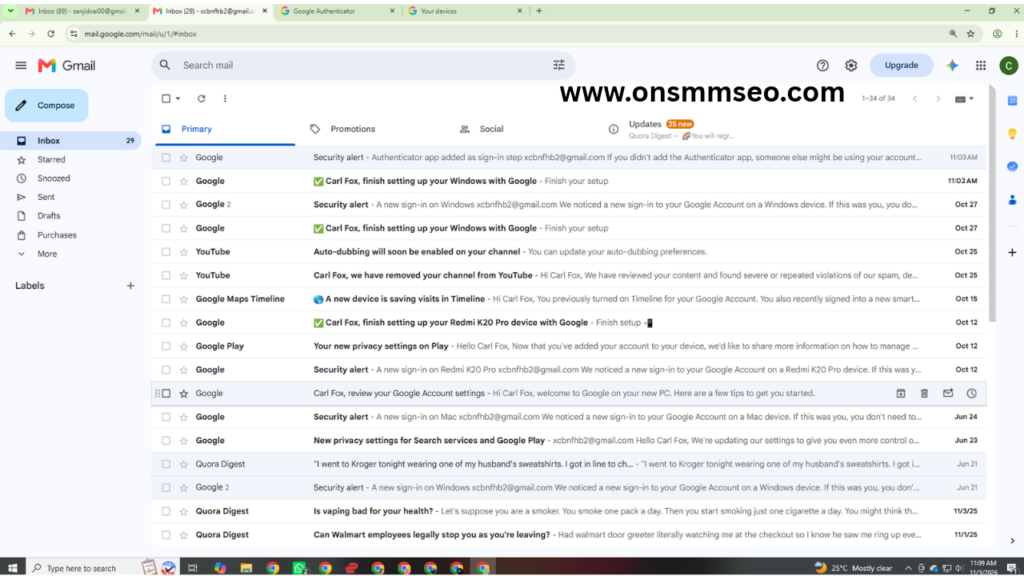
Why Account Age Matters for Gmail Users
Account age describes the period between an account’s original creation and the present date. It is one element of an account’s history, but it should not be confused with account quality.
For example, consider two Gmail accounts:
-
Account A was created several years ago and has been maintained by its original owner.
-
Account B was created recently and has complete security settings, updated recovery information, and regular legitimate activity.
Although Account A is older, Account B may have stronger security and more reliable ownership information.
Account age may matter in several situations.
Historical Records: Older accounts can preserve important correspondence and documents.
Professional Continuity: A long-standing email address can help maintain consistent communication with existing contacts.
Account Management: Users may prefer established accounts because they already contain familiar configurations and organizational settings.
Digital Identity: Email addresses are frequently connected to online services, professional profiles, and communication platforms.
It is important to understand that Google does not publicly guarantee additional privileges simply because an account is old. Account policies and security requirements still apply regardless of creation date.
Important Features of Old Gmail Accounts
Older Gmail accounts generally provide access to the same core Gmail features available to eligible newer accounts.
The available features depend on the account type, settings, storage capacity, and applicable Google policies.
Some important features include:
1. Email Communication
Gmail supports sending, receiving, replying to, and forwarding emails. Users can communicate with individuals, organizations, customers, and professional contacts.
2. Inbox Organization
Labels, folders-like organization, categories, filters, and search tools help users manage large collections of messages.
3. Spam Protection
Gmail includes automated spam detection that helps identify unwanted and potentially harmful messages.
4. Google Account Integration
Eligible Gmail accounts can provide access to other Google services, including Google Drive, Google Docs, Google Calendar, and Google Meet.
5. Contact Management
Users can maintain contact information and organize professional or personal communication networks.
6. Security Settings
Google provides security controls such as two-step verification, recovery options, security alerts, and connected-device management.
7. Storage Management
Gmail storage is connected to Google Account storage. Depending on the account and subscription, storage may be shared across Gmail, Google Drive, and Google Photos.
These features are not exclusive to old Gmail accounts. Most are also available to newer accounts.
Understanding Gmail Account Security and Privacy
Security is one of the most important considerations when managing any Gmail account.
An account may have existed for many years but still be vulnerable if its password is weak, recovery information is outdated, or unfamiliar devices have access.
A secure Gmail account should have several protective measures.
-
A strong and unique password.
-
Updated recovery email information.
-
A verified recovery phone number where appropriate.
-
Two-step verification.
-
Regular security reviews.
-
Monitoring of unfamiliar sign-in activity.
-
Careful management of connected applications.
Users should also understand that account ownership is important. Sharing or transferring credentials can create problems involving recovery, personal information, and access control.
Buying an account from an unknown third party can introduce additional concerns. The original owner may retain recovery access, previous sessions may remain active, and the account may contain private information.
For this reason, maintaining an account under its original owner’s control is generally safer than purchasing credentials from an unverified source.
Old Gmail Accounts vs. New Gmail Accounts – Which Is Better?
Both old and new Gmail accounts can support personal and professional communication. The better choice depends on the user’s requirements, security expectations, and account history.
| Comparison Factor | Old Gmail Account | New Gmail Account |
|---|---|---|
| Creation date | Earlier creation | Recent creation |
| Email history | May contain older messages | Usually limited history |
| Contact records | May have existing contacts | Usually starts with none |
| Account settings | May have established preferences | Requires initial configuration |
| Recovery information | May need updating | Can be configured immediately |
| Security | Depends on maintenance | Depends on security setup |
| Google services | Depends on eligibility | Depends on eligibility |
| Ownership history | Requires careful review | Easier to establish directly |
An old account may be useful when historical correspondence and existing records are important.
A new account may be preferable when a user wants a clean digital identity, direct ownership, and complete control over the initial security configuration.
Neither account type is automatically more trustworthy.
How Does Gmail Account Creation and Verification Work?
Creating a Gmail account involves establishing a Google Account and completing the information requested during registration.
The process generally includes several stages.
Step 1: Account Registration
The user visits Google’s official account creation page and provides the requested information.
Step 2: Username Selection
The user chooses an available Gmail address that meets Google’s requirements.
Step 3: Password Configuration
A strong password is created to protect the account.
Step 4: Verification
Google may request additional verification, such as a phone number or another verification method, depending on its security requirements.
Step 5: Account Information
Users may be asked to provide additional account information, including recovery details.
Step 6: Security Configuration
After registration, users can review their security settings, enable two-step verification, and check recovery options.
Verification helps Google assess account security and confirm information where required. However, verification does not mean that an account has permanent protection or guaranteed access to every Google service.
Users should always complete verification using their own legitimate information.

Why Do People Look for Buy Old Gmail Accounts?
The search phrase “Buy Old Gmail Accounts” appears in different online contexts. People searching for it may have different reasons, expectations, and levels of technical knowledge.
Understanding these motivations helps explain the popularity of the topic.
Established Email History
Some people are interested in accounts with a longer communication history because they associate account age with familiarity and continuity.
Business Communication
Businesses sometimes research established email addresses for administrative and communication purposes.
Marketing Research
Marketing professionals may investigate Gmail account management as part of broader studies involving digital communication, campaign administration, and audience management.
Personal Convenience
Some users prefer maintaining an existing email identity instead of creating multiple new addresses.
Organizational Requirements
Teams and organizations may research different email management approaches when planning communication systems.
However, purchasing another person’s Gmail account is not equivalent to acquiring a new business email service. Ownership, privacy, account recovery, and Google’s applicable policies must be considered.
For professional purposes, creating and managing accounts under the actual user’s or organization’s control is generally the more dependable approach.
Can You Buy Old Gmail Accounts Online?
Various online websites and third-party sellers advertise old Gmail accounts. However, the existence of these listings does not establish that the accounts are authentic, secure, transferable, or authorized for resale.
There are important considerations before trusting such offers.
Ownership Uncertainty: A seller may not be the original account creator or legitimate owner.
Recovery Problems: The original owner may still have access to recovery information or previously authorized devices.
Privacy Concerns: Older accounts may contain personal messages, contacts, documents, and confidential information.
Security Limitations: Previous sign-in activity or account restrictions may affect continued access.
Policy Considerations: Google controls account access under its applicable terms and policies. Purchasing credentials does not guarantee that an account can be transferred or used without restrictions.
Instead of relying on third-party account listings, users should consider official Google account creation and Google Workspace options when they need personal or organizational email access.
Old Gmail Accounts – Features, Access & Availability
An older Gmail account may provide access to several services depending on its account configuration and current status.
The most important elements to understand are account availability, ownership, security, and service eligibility.
Account Availability
An account may remain accessible as long as it meets Google’s applicable requirements and has not been disabled or deleted.
Account Access
Access normally depends on valid sign-in credentials and any additional security verification requested by Google.
Service Availability
Not every Google feature is necessarily available to every account. Certain features may depend on location, age requirements, account type, subscription, or eligibility.
Account History
The original account creation date and existing communication history may help establish its background, but they do not prove that its current user is the legitimate owner.
Recovery Access
Recovery options should remain under the legitimate owner’s control to reduce the possibility of losing access.
Users should understand these factors before making decisions about old Gmail accounts.
Benefits of Using Established Gmail Accounts
Established Gmail accounts can offer practical benefits when they are legitimately owned and properly maintained.
One important advantage is continuity. People who have used the same email address for years may have existing professional relationships, personal conversations, and important records connected to it.
Another advantage is familiarity. Long-term users may already understand the account’s organization, notification settings, labels, filters, and connected Google services.
For organizations, established email addresses can also support consistent communication when employees or departments have used them over an extended period.
Additional benefits may include:
-
Access to historical correspondence.
-
Existing contact information.
-
Familiar inbox organization.
-
Previously configured communication preferences.
-
Continuity across supported Google services.
-
Easier management of existing email records.
These advantages depend on legitimate ownership and proper maintenance. An older account obtained from someone else may not provide the same continuity.
How to Verify an Old Gmail Account?
Verifying an old Gmail account involves examining its account information, security configuration, ownership, and available access.
There is no single public verification tool that independently proves every aspect of an account’s history.
Users should consider the following checks.
1. Review Account Information
Sign in through Google’s official website and review the available account information.
2. Examine Security Settings
Visit Google Account Security to review sign-in methods, security alerts, and authentication settings.
3. Check Recovery Information
Confirm that the recovery email and phone number belong to the legitimate account owner.
4. Review Connected Devices
Examine the devices associated with the account and identify unfamiliar activity.
5. Check Recent Security Activity
Review available security events and investigate unexpected sign-ins.
6. Examine Account History
Existing emails, dated messages, and other historical records may provide context about account usage.
7. Review Account Status
Confirm that the account remains accessible and has not been disabled or restricted.
A particularly important distinction is that verifying account access is not the same as verifying account age or ownership.
Google’s official security tools should be the primary source for account-related checks.
Who Can Use Old Gmail Accounts?
Gmail supports many different types of users, including individuals, professionals, students, businesses, and organizations.
The suitability of an existing account depends on legitimate ownership and the intended purpose.
Personal Users
Individuals can use Gmail for personal correspondence, subscriptions, notifications, and maintaining digital records.
Students
Students may use Gmail to communicate with educational institutions, instructors, classmates, and other academic contacts.
Freelancers
Independent professionals often use email for project discussions, client communication, document sharing, and administrative activities.
Business Owners
Business owners may use Gmail or Google Workspace to manage customer communication, internal discussions, and professional correspondence.
Organizations
Nonprofit groups, educational institutions, and other organizations can use suitable Google email solutions for administrative communication.
Marketing Professionals
Marketing teams use email for legitimate business correspondence, campaign administration, research coordination, and client communication.
Each user should maintain accounts using appropriate ownership and security practices.
Affordable Old Gmail Account Options
People researching affordable old Gmail account options should understand the difference between an advertised account price and the actual cost of maintaining a reliable email system.
A low-cost account listing does not necessarily indicate quality, ownership, or long-term accessibility.
There are several legitimate alternatives to consider.
Free Gmail Accounts
Google offers personal Gmail accounts without a standard monthly subscription fee, subject to its terms and storage arrangements.
Google Workspace
Organizations that need professional email addresses associated with their own domains can explore Google Workspace plans.
Business Email Management
Businesses can establish accounts for employees and departments through an appropriate organizational email system.
Existing Account Maintenance
People who already own an older Gmail account can maintain it by updating recovery information, reviewing security settings, and organizing their inbox.
When evaluating affordability, users should consider security, administrative control, storage, support, and long-term access rather than account age alone.
When Should You Consider an Old Gmail Account?
An older Gmail account may be worth maintaining when it contains important records or supports an established communication identity.
For example, someone who has used the same email address for professional correspondence may prefer to continue using it rather than changing addresses and updating numerous contacts.
Similarly, a business owner may need to preserve historical communications connected to an existing company email workflow.
However, an old account is not automatically the right solution in every situation.
Consider an established account when:
-
You need access to historical email conversations.
-
Your existing contacts already recognize the address.
-
You want to preserve previous communication records.
-
The account is legitimately yours.
-
You can maintain its security and recovery information.
Consider creating a new account when you need a separate identity, a clean inbox, or a dedicated address for a new project.
Why Choose Gmail for Personal and Business Communication?
Gmail is widely used because it combines email communication with several other productivity and collaboration features.
Its interface is familiar to many internet users, and its integration with Google’s ecosystem makes it useful for different communication requirements.
Personal Communication
Individuals can send messages, share attachments, receive notifications, and maintain conversations with friends and family.
Business Correspondence
Businesses can communicate with customers, suppliers, partners, and employees.
Document Sharing
Integration with Google Drive and Google Docs supports document collaboration and file sharing.
Scheduling
Google Calendar provides scheduling tools that can support meetings, appointments, and business activities.
Team Collaboration
Google Workspace offers additional administrative and collaboration features for eligible organizations.
For companies that require professional branding, custom domain addresses such as [email protected] may provide a more suitable communication identity than a standard personal Gmail address.
Is Buying Old Gmail Accounts Safe and Reliable?
Buying old Gmail accounts from unknown sources can create significant ownership, privacy, and security problems.
The central issue is that an account’s original owner may retain information or recovery methods that allow them to regain access.
Even when a seller provides working login credentials, this does not establish permanent ownership or secure transfer.
Some important concerns include:
1. Account Recovery Conflicts
The original creator may still control recovery information or previously authorized devices.
2. Personal Information Exposure
An older account may contain confidential emails, attachments, contact details, and other private records.
3. Unexpected Restrictions
Google may apply security checks or account restrictions when it detects unusual activity.
4. Uncertain Account History
A seller’s claims about account age, activity, and verification may be difficult to independently establish.
5. Long-Term Access
A successful initial login does not guarantee continued access.
6. Policy Compliance
Users should review Google’s applicable terms and policies before considering any account transfer.
The safer approach is to create an account directly through Google or use an appropriate Google Workspace arrangement.
ONSMMSEO encourages readers to evaluate email account ownership, privacy, and security based on reliable information rather than promotional claims.
Where Can You Find Information About Old Gmail Accounts?
Reliable information about Gmail accounts should come from official documentation and established educational resources.
The following sources are useful for understanding Gmail features, account security, and recovery procedures.
| Information Source | Main Learning Area |
|---|---|
| Gmail Help Center | Gmail features and troubleshooting |
| Google Account | Account settings and personal information |
| Google Security | Security reviews and sign-in protection |
| Google Accounts | Account registration and sign-in |
| Google Workspace | Business email and collaboration |
| Google Account Help | Account recovery and management |
These resources are useful for students, business owners, digital marketers, and individuals researching email account management.
ONSMMSEO can also serve as an educational reference for understanding digital marketing, online communication, and account management concepts.
Understanding Gmail Account Age, Recovery & Security
Account age, account recovery, and account security are three different concepts that should not be confused.
Gmail Account Age
Account age refers to how long an account has existed. It provides historical context but does not independently establish account quality.
Account Recovery
Recovery refers to the process of regaining access when a user cannot sign in. Google may request verification or other information to help establish legitimate access.
Account Security
Security involves protecting the account from unauthorized access through passwords, two-step verification, security alerts, and recovery controls.
These elements work together.
For example, a Gmail account created eight years ago may have a substantial communication history. However, if its recovery email is outdated and its password has been exposed, its age provides little protection.
Similarly, a recently created account with strong security settings may be more dependable for everyday communication.
Users should therefore evaluate the complete account environment rather than focusing on one historical detail.
Old Gmail Accounts for Personal, Business & Marketing Use
Different users have different email requirements. Understanding these applications helps explain why Gmail account management is relevant across several industries.
Personal Use
Personal Gmail accounts support everyday correspondence, online notifications, document storage, and communication with friends and relatives.
For someone maintaining a long-standing account, historical conversations and saved contacts may be particularly valuable.
Business Use
Businesses rely on email for customer service, internal communication, supplier correspondence, scheduling, and document sharing.
An established business communication system can help maintain consistent contact with customers and employees.
However, companies should ensure that accounts are managed by authorized personnel rather than depending on credentials purchased from unrelated individuals.
Organization Use
Educational institutions, nonprofit organizations, and community groups may use Gmail-based systems for administrative communication.
Google Workspace can provide additional management capabilities where organizational requirements justify them.
Marketing Use
Digital marketing professionals use email for legitimate activities such as:
-
Client communication.
-
Campaign planning.
-
Marketing research.
-
Project coordination.
-
Business inquiries.
-
Reporting and collaboration.
-
Customer support.
Email marketing also requires appropriate consent, privacy practices, and compliance with applicable laws.
For marketing teams, account age should never replace proper permission, responsible communication, or professional account management.
Multi-Project Management
Freelancers and agencies sometimes organize different projects using separate, properly controlled email addresses. Clear account ownership and access management help prevent confusion when projects change or team members leave.
Best Practices for Managing an Older Gmail Account
Maintaining an older account requires regular attention. Long-term users should periodically review their account settings to ensure that their information remains accurate and protected.
Some practical recommendations include:
Update Recovery Information: Keep recovery options current and under your control.
Use Strong Passwords: Avoid reusing passwords across different online services.
Enable Two-Step Verification: Add another authentication layer to reduce unauthorized access.
Review Devices: Remove unfamiliar devices and investigate unexpected activity.
Organize Important Messages: Use labels, filters, and archiving to manage correspondence.
Check Storage: Review available Google Account storage and remove unnecessary files when appropriate.
Review Connected Applications: Remove third-party access that is no longer needed.
Maintain Privacy: Avoid sharing sensitive information through unsecured communication channels.
These practices are relevant to both old and new Gmail accounts.
Frequently Asked Questions About Old Gmail Accounts
1. What Is an Old Gmail Account?
An old Gmail account is an email account that was created some time ago and has remained available over an extended period. It may contain historical messages, contacts, settings, and communication records.
2. Does Gmail Account Age Matter?
Account age can provide historical context and continuity. However, Google does not guarantee additional privileges, stronger security, or special features based solely on account creation date.
3. Are Old Gmail Accounts Better Than New Ones?
Not necessarily. Old accounts may contain valuable historical records, while new accounts can provide a clean starting point and easier initial configuration. The better option depends on individual requirements.
4. Can I Buy Old Gmail Accounts Online?
Some third-party websites advertise old Gmail accounts. However, purchasing credentials from unknown sellers can create ownership, privacy, recovery, and policy problems. Creating and maintaining your own account is generally safer.
5. How Can I Check the Age of My Gmail Account?
You can investigate available account information and historical records. Depending on the account, relevant details may appear in original registration information or older account-related emails. There is no universal public account-age verification tool.
6. Are Verified Gmail Accounts More Secure?
Verification can help establish account information and support Google’s security processes. However, verification alone does not guarantee permanent protection. Strong passwords, recovery settings, and two-step verification remain important.
7. Can an Old Gmail Account Be Recovered?
In some situations, yes. Users should follow Google’s official account recovery process and provide the information requested. Recovery is not guaranteed in every case.
8. Can Old Gmail Accounts Be Used for Business?
A legitimately owned Gmail account can support business communication. Organizations that need employee management and custom domain email addresses may benefit from Google Workspace.
9. Does Account Age Affect Gmail Features?
Most standard Gmail features are available to eligible old and new accounts. Access to particular services may depend on account type, eligibility, location, and Google’s current policies.
10. What Should I Check Before Using an Old Gmail Account?
Review ownership, recovery information, security settings, recent activity, connected devices, account status, and available storage.
11. Can an Old Gmail Account Be Used for Marketing?
Gmail can support legitimate marketing-related communication, research, and project coordination. Users should follow Google’s policies and applicable email marketing and privacy regulations.
12. Why Is Account Recovery Important?
Recovery information helps legitimate owners regain access when they forget their passwords or encounter sign-in problems. Keeping recovery details updated is an important part of account maintenance.
Conclusion
Old Gmail accounts remain an interesting topic for individuals, businesses, organizations, and digital marketing professionals. Their historical records, existing contacts, familiar settings, and long-term communication history can provide practical value when accounts are legitimately owned and properly maintained.
However, an account’s age should never be treated as proof of reliability, security, or ownership. A verified account is not necessarily permanently secure, and purchasing credentials from an unknown seller can introduce privacy and recovery complications.
Before making decisions about old Gmail accounts, users should understand account creation, verification, security, recovery, and Google’s applicable policies. For individuals who need dependable communication, creating their own Gmail account or selecting an appropriate Google Workspace solution provides a clearer foundation for long-term account management.
ONSMMSEO aims to provide informative resources about digital communication, online account management, SEO, and digital marketing. By understanding the differences between account age, verification, and security, readers can make more informed decisions about their personal and professional email requirements.





Reviews
There are no reviews yet.